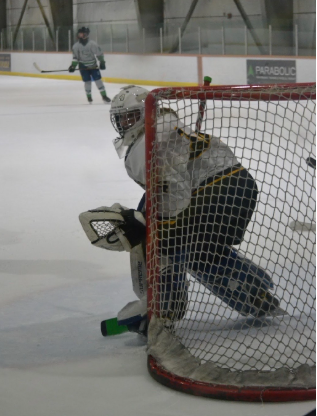
Blades sharply cut into the ice, spraying snow with each glide. The puck races toward the goal as others chase after it, sticks in hand, scraping and sliding, trying to alter the next move of the black disc. The player in front of the goal, who practices on the ice seven days a week, is Brielle Sisco. She breaks her stance and dives to the ice, hitting the puck and pushing it outward.
“From a young age, my older brother inspired me to start playing the sport I now love: hockey,” Sisco says.
Following her brother’s footsteps, Sisco’s only dream has been hockey. From watching him fiercely play on the ice to tying her own skates and swinging sticks at pucks, she realized that hockey is a competitive and exciting sport.
“Brielle plays on several club teams, as well as being on varsity. She’s really good at what she does,” freshman Isabella Holman says.
Since most of Sisco’s life revolved around hockey and other sports, she was constantly striving for more, always determined to improve and prove herself. “I was on the ice seven days a week, sometimes multiple times a day,” Sisco says.
Many of her friends show strong support for her hockey career. One friend, freshman Emily Vetter, stated, “Ever since I’ve known Brielle, she has played hockey and has only gotten better from there. I know she also plays on a team with just guys, mostly because she likes the competition.”
While sports are a part of many people’s lives, whether on the field or rink, catching footballs or swinging at pucks, in front of many spectators or relaxing on the couch watching a game, most people know that athletes are at some risk of injury, whether it’s tearing a muscle or straining a limb. In hockey, with its wide range of motion, injuries are common, so it’s important not to overwork yourself and to know your limits.
“Just recently, I ended up injuring my hip because I was overusing it,” Sisco said. “I’ve had to take more rest days and be more cautious of how I’m playing.”
According to PubMed Central, an online database of articles, various injuries are possible in hockey. Hip and lower limb injuries are often caused by overuse. A study showed that about 75.5% of youth hockey players ages 15-20 experience hip problems. Research suggests that young athletes who start pursuing hockey before middle school (ages 11-14) are more likely to develop hip dysfunction, which can seriously affect their daily lives.
As Sisco recovers from her injury, she reflects on what she could have done differently. “My hip can’t heal entirely on its own; the only way for it to heal is with surgery, which I don’t think I’m going to get right now. I’ve been undergoing physical therapy and taking time to recover,” she states. “Honestly, I regret playing and practicing on the ice 24/7. I was overworking myself and coming home tired after most practices.”
Sisco remains on the ice, stick in hand, not letting an injury stand in the way of her lifelong dream.