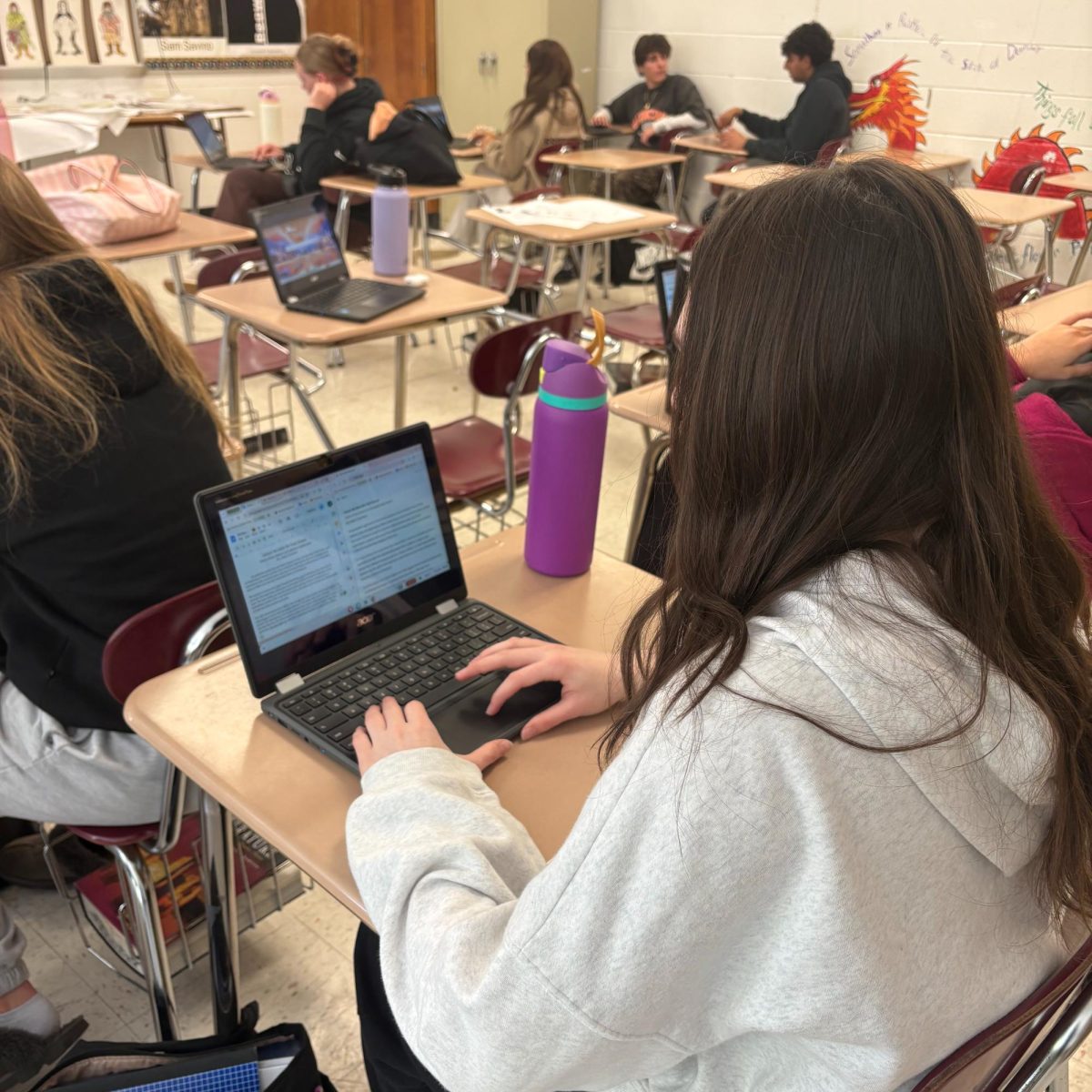
With skills like analyzing organic life systems and breaking down complex chemical reactions, students are competing in the New Jersey Science League (NJSL) this year, bringing KHS back into the statewide science competition after an eight-year absence.
This year, KHS is renewing its participation in NJSL to give students more opportunities for extracurricular science experiences. A total of 34 students are participating in subjects such as biology, chemistry, anatomy and physiology, physics, environmental science, and forensics.
While science teacher Nancy Rinaldi and physics teacher Jenny George are responsible for coordinating NJSL tests at KHS, Dr. Mal Sturchio started NJSL in 1962 as a test-taking club in chemistry. Tests in the science subjects range from regular to Advanced Placement levels, and NJSL allows students to compete with other NJ students in these areas.
Across New Jersey, tests for the competition are administered on the third Thursday of each month from January through April. Each test has a varying number of multiple-choice questions and a 50-minute time limit. However, students can only compete in one subject, and it must be a class they are currently enrolled in.
“I’d say the [NJSL] test had similar content to my regular science tests, but it was harder because it covered a lot of curriculum in one test instead of only one unit,” said junior Joseph Laborsky, who competed individually for honors physics.
NJSL also offers students several ways to compete and earn recognition: students can compete individually or in a team. Individuals must take at least three of the four tests to qualify for awards, with scores determined solely on the percentage of correct answers. Teams must have at least two individuals and can have an unlimited number of individuals per team, but only the top six scores per month will be considered. Team scores are calculated by adding the highest two scores per team across all four testing months.
Students can earn certificates of achievement by completing three out of the four tests and placing in the top six scores for their test that month. Individual students who meet those requirements and rank within the top ten percent of individual competitors statewide can earn plaques. Teams of students that rank in the top ten percent of team competitors are also eligible for plaques.
However, for some students, success isn’t defined solely by ranking. “I’m not really focused on placing; my main goal is to gain more confidence with physics overall and get myself into the flow of studying for future tests, not just the NJSL competition,” said Laborsky.
Similarly, other students participated with goals other than winning. “I competed individually for honors chemistry because I needed another extracurricular activity, and I wanted to see what information I already knew for my chemistry midterm,” said sophomore Emily Sun.
Along with midterms, NJSL tests precede Advanced Placement (AP) exams held at the beginning of May. Chemistry teacher Adam Smith said that by participating in NJSL, students can practice being “proficient in many topics at once, some of which were learned months or even over a year ago, which is very relevant to preparing for an AP exam.”
Smith has been encouraging his chemistry students to participate and has been sharing past test questions for practice. “[Students] seemed enthusiastic for the January exam, and I hope we keep up that energy and perform well in the remaining three months, as things typically get more challenging. It is good to have [NJSL] back, and I am happy to see the list of everyone involved,” Smith said.