College recruitment can be both an open door and an endless maze for talented high school athletes. It appears to be a process of simply working hard, getting noticed, and receiving a scholarship; however, the process is far more complicated.
The process has evolved and begins years before coaches are even allowed to make contact. With increasing reliance on club programs and elite sports organizations, high school athletes are truly put to work when getting recruited. The financial, academic, and emotional pressures are often understated. For many student-athletes, navigating the system requires balancing training and the realities of college life.
“They’re [athletes] not able to be recruited until junior year, so I usually start putting it in their minds sophomore year,” said Nicholas Gebhardt, Track and Field Coach at Kinnelon High School.
Far before coaches can make contact, athletes have to start thinking about whether or not a college sports career is a fit for them. “I first realized playing in college was realistic in seventh grade, when my club team got serious,” said Madison Mortimer, a senior lacrosse player committed to Division I Women’s Lacrosse at Mercer University.
Athletes should begin considering if they want to continue their sport and at what level as young as possible. Steven Racine, Kinnelon’s girls soccer coach and former Morris Catholic coach, whose teams have won 12 NJSIAA titles and 16 sectional championships, explains that getting involved with club teams early can help with recruitment. “Today, most recruiting is done through clubs, not high schools,” said Racine.
Mortimer began reaching out to colleges freshman year. “It all started freshman year of high school when I began reaching out to colleges. Schools would watch me at prospect days, camps, and club tournaments,” she said.
The pressure is intense and a lot for young high school athletes to take on. Life becomes a cycle of camps, clinics, and balancing life with sports. “There’s definitely a lot of pressure, especially knowing there are multiple colleges on the sideline watching you,” Mortimer said.
Alessia Cerulo, a freshman playing Division I soccer at College of the Holy Cross, had similar experiences: “It was a stressful experience because schools were reaching out when I was extremely young, and I didn’t even know what I wanted from college yet,” said Cerulo.
Division I athletics have a high commitment demand. “Going D1 is more like a job. There’s a bigger commitment because you’re usually getting more scholarship money. At the D3 level, there’s no athletic funding, so the focus is more on academics, and there’s much less stress,” said Gebhardt.
High school coaches truly help their athletes understand the different expectations at each level. “I don’t generally recommend Division I unless that’s the school of their choice. The commitment is extreme; they really own you. I always make sure my athletes are considering their academics first and helping them understand that they may not always get play time. So many clubs push D1 to inflate their stats, but sometimes I feel like athletes could benefit more from the D3 or other levels,” said Racine.
Success is not always guaranteed, even for recruited, talented athletes. “People think it’s easy to get recruited, but it’s a lot harder than you think. And it doesn’t guarantee you’ll get playing time, or even be on a team at all. It doesn’t even guarantee that you will be happy. You still have to work hard every day,” said Cerulo.
Along with commitment, scholarships are often misunderstood. “The biggest misconception is that you’re guaranteed a huge scholarship when getting recruited. Most of the time, you’re not,” Gebhardt said.
Athletes should understand that, regardless of talent or status in a club, scholarships are still hard to obtain. “A huge misunderstanding is that you’re spending all this money on club sports, and it’s eventually going to come back as a scholarship. Financially, it rarely does.” NCAA data shows that only a small percentage of high school athletes receive any athletic scholarship. “Outside of big sports like football and basketball, full scholarships are not likely,” Racine added.
A huge benefit for athletes is that recruitment can help bypass competitive selection in college admissions. “It’s definitely a big advantage. My coach told admissions who her recruits were, and they let us in,” Mortimer said.
This doesn’t mean academics are not considered. College sports and recruiters monitor GPA and academic effort, and have expectations for prospects to work hard. “School is the more important component. I always want to know what athletes are going to major in before helping them pick their sports program,” Gebhardt said.
The pressure and hard work from athletes pay off in results and self-pride. “Signing my NLI was the most rewarding part, knowing that 11 years of lacrosse was finally paying off,” Mortimer said.
“Less than one-tenth of one percent of athletes ever make a living from sports. The priority should be playing, getting a good education, and having a good experience,” Racine said.
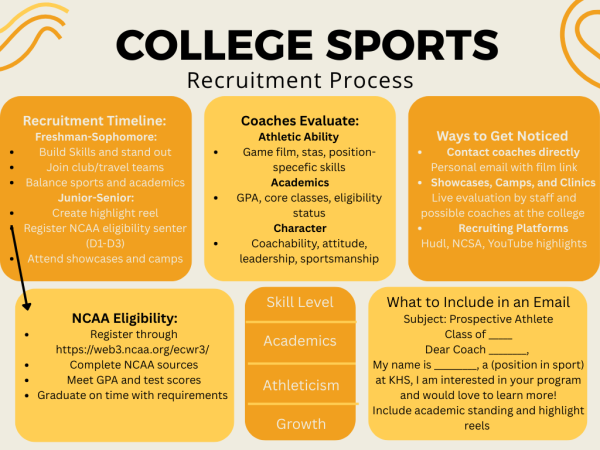
Life for prospective athletes consists of early exposure, financial investment, and intense expectations. Finding balance between athletics and academics is often the most important goal for student-athletes and their families.